Đang tải...
Vui lòng chờ trong giây lát
Đang tải...
Vui lòng chờ trong giây lát
Đang tải...
Vui lòng chờ trong giây lát

On the morning of 14 October 2026, in Phu Tho Province, Airports Corporation of Vietnam (ACV) held a conference on digital transformation, reaffirming its commitment to shifting from information-based management to data-driven operations and from standalone systems to integrated, interconnected platforms. Working closely with airlines, aviation fuel suppliers, ground handling service providers and technology partners, ACV is accelerating digital transformation and progressively embedding technology as a core capability in airport operations.
The conference was chaired by Nguyen Cao Cuong, Chairman of ACV’s Board of Directors, and Nguyen Duc Hung, Acting General Director of ACV, with the participation of leaders from ACV’s Technical & Environmental Department and representatives of relevant units. Attendees also included Mr. Dao Xuan Hoach, Deputy Director General of the Civil Aviation Authority of Vietnam (CAAV), and representatives of the Northern, Central and Southern Airports Authorities. Representatives from Vietnam Airlines, Sun PhuQuoc Airways, Vietravel Airlines, Vietnam Air Petrol Company Limited (Skypec), Vietnam National Petroleum Group (Petrolimex), Vietnam Airport Ground Services Company Limited (VIAGS), and technology partners GTINX and BSI Vietnam also attended the conference.

ACV Chairman of the Board of Directors Nguyen Cao Cuong delivers the opening remarks.

ACV Acting General Director Nguyen Duc Hung addresses the conference.

Overview of the conference.
Digital Transformation in Airport Operations Management
Airport operations require continuous coordination among airport operators, airlines, air traffic management units and aviation service providers. Digital transformation therefore extends beyond technology adoption to encompass data connectivity, process standardization and more effective coordination, enabling stakeholders to make proactive decisions based on consistent, timely and reliable information.
In its report on digital transformation, ACV’s Technical & Environmental Department highlighted the Airport Collaborative Decision Making (A-CDM) model as a key initiative toward automated operational management and its wider implementation across ACV-operated airports. Experience at Noi Bai International Airport and Tan Son Nhat International Airport has demonstrated tangible benefits. At Noi Bai, the on-time performance (OTP) rate reached 71.47%, while outbound taxi time was reduced by nearly 1.5 minutes per flight. At Tan Son Nhat, optimized aircraft taxiing operations contributed to fuel cost savings of more than USD 3.7 million.
Building on these results, Noi Bai International Airport presented solutions to improve data quality, reduce manual processes and strengthen connectivity among operational systems. Key priorities include exploring Application Programming Interface (API) integration, automating data sharing and further developing the Airport Operational Database (AODB). These measures are expected to enhance data accuracy, timeliness and overall operational efficiency. Drawing on experience at Noi Bai and Tan Son Nhat, ACV plans to implement A-CDM at Da Nang International Airport in phases while assessing opportunities to extend the model to other suitable airports.

A representative of the Northern Airports Authority speaks at the conference.
For Long Thanh International Airport, studying and integrating operational management solutions during the preparation phase will establish a foundation for coordinated operations, helping improve efficiency and readiness from the outset of airport operations.
Connecting Data Across the Operational Chain to Optimize System-wide Efficiency
In addition to A-CDM, data connectivity with ground handling service providers, aviation fuel suppliers and airlines is essential to optimizing the entire airport operational chain. Timely information sharing enables stakeholders to proactively coordinate personnel, equipment and service plans, thereby reducing waiting times, improving resource utilization and supporting on-schedule flight operations.
In its presentation, VIAGS emphasized the standardization of data connectivity with ACV, the application of artificial intelligence (AI) in operational management, and research into combining AI with dedicated 5G infrastructure. Proposed initiatives include establishing a centralized data platform, digitizing operational processes, developing an integrated operations center, and applying AI to workforce planning, resource allocation, performance monitoring and equipment coordination.
For Long Thanh International Airport, coordinated implementation of fiber-optic infrastructure, technical utility tunnels and interconnection arrangements among relevant stakeholders will be essential to ensuring reliable connectivity and stable operations from the initial stages.

Representatives of Skypec and VIAGS actively contribute presentations and discussions aimed at strengthening coordination and improving resource utilization in airport operations.
In aviation fuel supply, Skypex highlighted the application of science and technology and digital transformation in managing and operating fuel supply activities. Strengthening information connectivity with flight schedules will improve coordination, support more efficient resource allocation and help meet the stringent safety requirements of aviation operations.
For airlines and other service providers, system integration must be underpinned by standardized data, clearly defined information exchange procedures and responsibilities for updating information, while ensuring compliance with information security requirements. This approach will provide a foundation for gradually extending connectivity to other operational areas, including meteorology, catering and aircraft engineering, helping establish a more integrated, synchronized and efficient aviation operational chain.
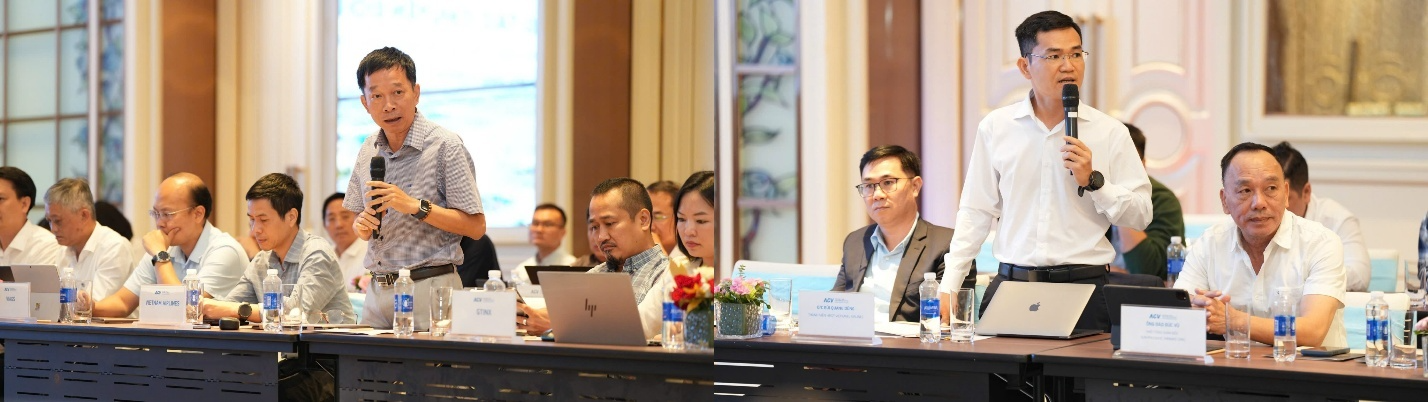
Representatives of airlines share their perspectives at the conference.
Building Technology Foundations, Applying AI and Enabling Proactive Operations
In its presentation on ACV's digital transformation roadmap, GTINX, together with relevant consulting and technology partners, emphasized the need to align business objectives, operational requirements, technology platforms and human capabilities. The implementation roadmap should begin with defining a strategic vision, assessing the current state and identifying the needs of individual units. These assessments will provide the basis for developing a data architecture, selecting priority projects and establishing appropriate governance mechanisms.

Representatives of Global Technology Industry Corporation (GTINX) present on digital transformation.
Alongside the overall digital transformation program, the early implementation of initiatives capable of delivering tangible benefits in the short term, commonly known as “quick-win” projects, was also proposed. Priorities include standardizing LAN/WAN and Wi-Fi infrastructure, strengthening centralized IT monitoring, enhancing server and storage capacity, improving data backup capabilities, and reinforcing information security systems.
At airports where conditions permit, integrating data from the Airport Operational Database (AODB), Flight Information Display System (FIDS), surveillance cameras and other relevant sources into an integrated operations center could support real-time operational monitoring, incident alerts and improved response capabilities.
On this foundation, AI and data analytics offer opportunities to move beyond reactive incident handling toward predictive analysis and proactive operational management. Potential applications include forecasting passenger traffic and aircraft turnaround times, supporting aircraft stand and boarding gate allocation, monitoring equipment conditions, and developing predictive maintenance capabilities. In ground handling operations, AI and computer vision could also assist in equipment monitoring, identifying potential safety hazards and improving resource coordination, subject to operational requirements and implementation conditions.
To ensure these solutions deliver their intended benefits, data connectivity must be accompanied by robust access controls, vulnerability management, cybersecurity monitoring, data backup and incident response capabilities. For critical operational systems in particular, integration must incorporate appropriate network segmentation and data flow controls to safeguard operational safety and system reliability.
Strengthening Governance and Digital Workforce Capabilities for Sustainable Development
Digital transformation must go hand in hand with management innovation, process standardization and the development of digital workforce capabilities. Solutions such as smart digital offices, electronic document management, digital signatures and enhanced data integration can improve management efficiency, transparency and decision-making.
Meanwhile, BSI Vietnam's presentation highlighted the role of Environmental, Social and Governance (ESG) principles and sustainability reporting, underscoring the links between digital transformation, resource optimization and emissions reduction in aviation operations.

Representatives of BSI Vietnam present on ESG and sustainable development.
Building on the discussions and recommendations at the conference, ACV aims to advance coordinated digital transformation tailored to the conditions of individual units, prioritizing practical solutions and strengthening connectivity across its airport network. Alongside the development of technology infrastructure, improvements in data quality and the application of AI, workforce training and closer collaboration among airports, airlines, fuel suppliers, ground handling service providers and technology partners will be essential to achieving measurable results.
The ultimate goal of digital transformation is not simply to introduce more advanced systems, but to build smarter operational capabilities, stronger connectivity and a more sustainable development model. Through its commitment to innovation and industry-wide collaboration, ACV seeks to translate technological advances into tangible benefits for airport operations, passengers and the development of Vietnam's aviation sector, progressively developing modern aviation gateways that connect Vietnam with the region and the world in the digital era.
News and photos: Administration Department